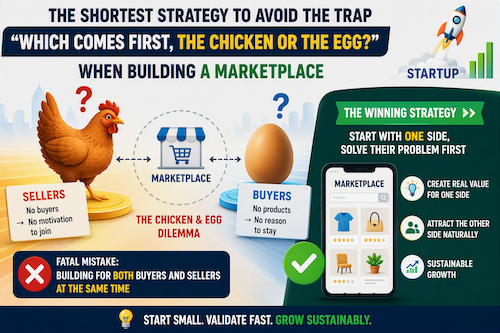
A dangerous mistake many founders make is trying to build a complete product for both buyers and sellers from day one. A more effective approach is to prioritize one side, create real value through manual work, and then use those results to attract the other side. Practical insights from mentoring the Steply project, Summer 2026.
When founders begin building a two-sided platform, or a two-sided marketplace, they often make a mistake that can drain their resources before they find a viable market: trying to build an application for buyers and sellers at the same time.
1. From Steply to the chicken-and-egg paradox
In the summer of 2026, one of the projects I had the opportunity to work with was Steply - a project from FPT University - a platform that encourages people to stay active and earn rewards by walking or completing missions. You can learn more in Money X's Projects category.
Steply has two primary customer groups:
- B2C customers, or users: people who walk regularly, want to maintain an active lifestyle, and want to receive additional rewards for completing missions.
- B2B customers, or businesses: game companies, banks, e-commerce platforms, and brands that want to sponsor missions to promote products, drive engagement, or acquire customers.
This creates a familiar paradox: without enough active users, businesses have little reason to pay for sponsorships; but without sponsoring businesses, Steply lacks the resources to maintain attractive rewards for users.
Does Steply need to develop both sides of the marketplace at the same time? The short answer is: not necessarily.
This is why I wrote this article: to help Steply and other two-sided platforms avoid the potentially fatal mistake of spreading their resources too thin, while finding the right validation sequence before making major product investments.
When both sides are built simultaneously, the buyer-facing landing page may not have enough products or offers to choose from, while the seller-facing interface has too few customers. The team must run two acquisition systems, two user journeys, and two different sets of problems, yet neither side reaches enough density to generate transactions.
The mistake: treating the completion of two applications as a prerequisite for having a marketplace.
A better perspective: a marketplace exists when it has a mechanism for exchanging value that is attractive and frequent enough. Software is simply a tool for making that mechanism operate more efficiently.
The two sides of a marketplace rarely have the same role, acquisition cost, or level of risk. Founders should examine at least four factors:
- The asset-creating side: the side that generates supply, content, data, or value that can accumulate over time.
- The hard-to-acquire side: the side with a long sales cycle, high trust requirements, or a need for hands-on support.
- The side that can be subsidized: the side that can join for free or be incentivized during the early stage to create network effects.
- The paying side: the side with budget and motivation to pay once the platform proves its results.
“Choosing one side” does not mean abandoning the other. It means choosing one side as the launch engine and serving the other through a small-scale manual process. Once value and data have been created, the platform can automate and expand.
AngelList: build startup supply and make selective connections
A key lesson from the early stage of platforms that connect startups and investors is this: before building a complex matching system, the team can curate high-quality profiles, establish trust, and make the first connections manually. Early value comes from the quality of selection and the ability to create meaningful connections, not from the number of features.
eBay: focus on a community with a clear need to tradeeBay began as AuctionWeb and created a place where buyers and sellers could trade directly. Its famous first transaction involved a broken laser pointer. The lesson is not that the founder should personally broker every transaction; rather, the platform began with a simple trading mechanism and later added trust-building tools such as a feedback system as the community grew.
Airbnb: seed initial supply and improve listing qualityAirbnb began when its founders rented out sleeping space in their apartment during a period of limited accommodation in the city. Later, the team met hosts directly and helped improve listing photography. This is a classic example of seeding supply, focusing on a narrow market, and manually addressing barriers related to trust and quality.
The goal of manual work is not merely to save development costs. Its greatest value is helping founders uncover customer insights that a dashboard cannot yet provide: why users decline, what conditions make a transaction happen, where trust comes from, and what brings people back.
At the early stage, the team can:
- Recruit suitable users one by one instead of running broad advertising campaigns.
- Match missions and rewards through a spreadsheet instead of building an automated system.
- Call or interview users after every mission to understand their real motivations.
- Manually reconcile data, send reward codes, and report results to businesses.
- Automate only after a task has been repeated enough times and has a clear, predictable pattern.
For Steply, the first reasonable hypothesis to validate is: whether a specific group of users is willing to walk and complete missions consistently in exchange for rewards. If this behavior has not yet been proven, selling advertising or sponsorships to businesses will be very difficult.
| Stage | Goal | Lean approach | Metrics to track |
|---|---|---|---|
| 1. Choose a niche | Create initial user density | Select a narrow community, such as students at one campus or employees of one company | Number of eligible participants |
| 2. Create missions | Validate behavior | Run a 7- to 14-day walking challenge with simple rewards provided by the team | Start, completion, and return rates |
| 3. Operate manually | Understand friction | Use chat groups, forms, reward codes, and spreadsheets for reconciliation | Operating cost per completed participant |
| 4. Package the evidence | Create a B2B asset | Prepare a report on engagement levels and post-mission behavior | Engagement, completion, and feedback rates |
| 5. Run B2B sales tests | Validate willingness to pay | Invite 3 to 5 businesses to sponsor a small campaign | Number of proposals, pilot contracts, and revenue |
- Recruit 100 users from one single community.
- Run a 14-day walking challenge.
- Set a minimum target of 40% mission completion and 25% participation in a second challenge.
- Interview at least 15 users who completed the challenge and 10 who dropped out.
- Use the results report to pitch a small sponsored campaign to businesses.
Note: these thresholds are experimental targets, not industry benchmarks. Steply should adjust them based on the characteristics of its community, reward value, and mission frequency.
A marketplace should not report only the number of registered accounts. For Steply, a unit of liquidity could be defined as: an eligible user receives and completes a mission sponsored by a partner, the data is verified, the reward is delivered, and the partner receives the agreed results.
The priority metrics should include:
- The percentage of users who move from receiving a mission to starting it.
- Mission completion rate.
- Average time to complete a mission.
- Return rate for the next mission.
- Reward and operating cost per valid completion.
- The percentage of businesses that agree to run another campaign.
- Which side contains the riskiest assumption? If that assumption is wrong, can the business model still survive?
- Which side creates a compounding asset? This could be supply, behavioral data, content, reputation, or community.
- What is the marketplace’s unit of liquidity? A connection, a transaction, a completed mission, or a returning customer?
- Can the first 10 to 50 transactions be completed manually? If not, what is the real barrier?
- Which part needs software right now? Build only what is necessary to reduce risk; do not build the entire future system in advance.
- When should you expand to the other side? Set clear thresholds for completion, retention, cost, and willingness to pay.
The chicken-and-egg problem is not solved by building two bigger cages. It is solved by choosing a sufficiently narrow starting point, creating real value for one side, and using that evidence to bring the other side in.
For Steply, prioritizing a small user community, proving that it can create habits and mission completion, then packaging the data into a pilot proposal for businesses is less risky than simultaneously developing a complete B2C application and a complex B2B portal.
In brief
- You do not need to develop both sides at the same time. Prioritize the side that creates foundational value or is harder to acquire, depending on the risk hypothesis you need to validate.
- Liquidity matters more than registrations. A marketplace becomes meaningful only when both sides create transactions or recurring value-producing behavior.
- The first 10 to 50 transactions can be operated manually. Google Forms, chat groups, email, and spreadsheets are often enough to validate demand before automation.
- For Steply, prove user engagement first. Data on steps, mission-completion rates, and reward redemption will become an “asset” for persuading sponsoring businesses.
- You are not choosing one side forever. The goal is to find a “wedge,” or initial breakthrough point, then gradually open the other side once you have evidence of value.