Under Decree 268/2025/ND-CP, innovation support policy is starting to shift from “inputs” to “outputs” - in other words, from research to commercialization. The voucher mechanism opens a new path for startups. This article summarizes how vouchers work, their benefits, risks, impact on startups, government, and the market.
VOUCHERS AND ONE-PERSON COMPANIES: A NEW LEVER FOR VIETNAMESE STARTUPS
In a market where many Vietnamese startups still struggle to commercialize their products, vouchers are seen as a new push that brings innovation closer to the market. At the same time, the “one-person company” model shows how technology, AI, and automation can help an individual run a lean but effective business. Together, these trends point to a major shift: the startup ecosystem is moving from supporting production to supporting actual sales.
WHAT IS A VOUCHER?
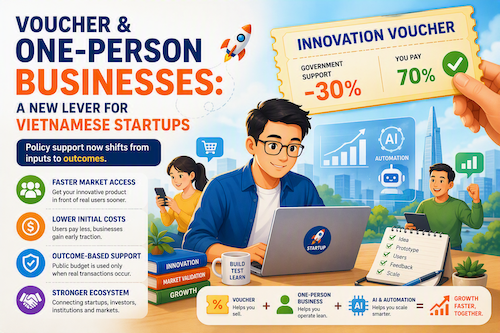
A voucher is state support given to users or businesses when they try an innovative product or service. Instead of giving cash directly to the startup, the budget is only released when a real transaction takes place. For example, if a product costs VND 10,000 and receives 30% support, the buyer pays about VND 7,000, while the remaining amount is reimbursed to the business after the transaction is confirmed.
The key advantage is that public money is only spent when the market actually responds. That makes the policy more transparent and lowers the risk of spreading support too thin. It also reduces the cost of trial for early customers, giving startups a better chance to attract users, collect feedback, and improve their products faster.
HOW HAS THE NEW LAW OPENED THE DOOR?
One important change is Decree 268/2025/ND-CP, which guides the Law on Science, Technology and Innovation and introduces the financial support voucher into the policy system for the first time. This is no longer just broad support; it is a direct tool for product commercialization and market expansion.
Vouchers can work alongside other mechanisms such as interest-rate support, venture funds, and tax, land, and infrastructure incentives. In other words, the government is no longer only supporting startups during research, but also stepping into the stage that matters most: turning a good product into one people actually buy.
WHO BENEFITS?
For startups, the biggest gain is a shorter path to market. Products that often get stuck at marketing, distribution, or early adoption now have a better chance to reach first-time buyers. For product providers, vouchers reduce sales pressure in the early stage and generate market data that helps refine the business model.
For users, vouchers lower the cost of trying something new, making them more willing to experience innovation without bearing the full risk. For the government, the policy makes public spending more targeted because it pays for real outcomes, not just ideas or proposals.
THE MAIN UPSIDES
First, vouchers create a startup’s “first customers,” which many young businesses lack. Second, they help the market respond earlier, so founders can see what products have real demand and what needs adjustment. Third, transaction-based reimbursement makes the policy easier to monitor and more transparent than direct grants.
At the ecosystem level, vouchers can encourage stronger links between startups, universities, support funds, and distributors. In short, this is a tool that pulls demand forward rather than just pushing supply.
WHAT TO WATCH OUT FOR
Despite its promise, a voucher is not a magic wand. If approval procedures are too slow, eligibility criteria too narrow, or payment channels too cumbersome, startups may still struggle to access the support. If the program focuses too narrowly on only a few sectors, promising products outside the priority list could be left out.
Another risk is that businesses may start chasing vouchers instead of real customer demand. That is why vouchers only work well when they are designed as a bridge to market validation, not as a long-term replacement for revenue.
ONE-PERSON COMPANIES: A RELATED TREND
As AI, management software, chatbots, marketing tools, and automation continue to evolve, one person can now do work that once required a full team. This is especially relevant for early-stage startups, where speed and cost control matter more than headcount.
For Money X, this is an important signal. The startup of the future will not only need capital, but also smart systems that help it operate leanly. Vouchers help with sales, one-person companies help with operations, and AI connects the two into a new growth model.
CONCLUSION
Vouchers are a notable policy shift because they bring state support closer to the real market. Together with the one-person company model, they could become two new levers that help Vietnamese startups shorten commercialization time, reduce trial costs, and improve survival in the early stage. If implemented transparently, with clear goals and simple procedures, vouchers could become a highly valuable startup support tool in the new phase of growth.