
In late 2022, after leaving my full-time role in banking, I began looking for a new direction. As I searched for creative ideas, I found myself thinking about the Jewish people: Einstein, Freud, Brin, Spielberg, and Zuckerberg, all of whom have helped shape the modern world; the wall built to keep out zombies in World War Z, built on the principle that one person must always challenge the other nine; and Start-Up Nation, the book that tells the story of Israel, a small, resource-constrained country that faces constant challenges yet has become one of the world's leading start-up ecosystems by density.
Searching for a Creative Method
Setting aside genetics and culture, I kept asking myself whether there was a specific creative method from the Jewish people that we could learn from. Research on Israel often suggests that its success does not come from any inherent “national exceptionalism,” but from factors that can be studied and replicated: compulsory military service that develops leadership and adaptive thinking from an early age, waves of immigration that bring diverse perspectives, and a culture that is comfortable with failure. In other words, creativity here is not a mystery. It is a system.
In Vietnam, I had never encountered a school or workplace that taught creative thinking in such a structured way. That led me to enrol in Cracking the Creativity Code, a Coursera course taught by Professor Shlomo Maital of Israel's Technion Institute of Technology. The course introduced ZiZoZi, short for Zoom In - Zoom Out - Zoom In, a method that Israeli students practise from their university years.
The course defines creativity in a highly practical way: creativity is the ability to expand the range of available choices. It is a skill that can be developed through practice, not a gift reserved for a select few. I learned it and enjoyed it so much that I made not just one, but two videos about it on the Moneyholic™ YouTube channel. If you are interested, you can watch An Introduction to ZiZoZi and Three Steps to Practise ZiZoZi to explore further. I call this my First Enlightenment.
ZiZoZi has been with me since the early days of building Money X, through internal projects, work with start-up teams and SME operators, and my role as an advisor to start-up projects at Universities. Like Israeli students, I believe young people should practise this way of thinking while they are still at university, rather than wait until after graduation and employment to encounter it.
Building a Start-up is Not Just Trading
A creative idea has real value only when it combines two elements: Discovery (novelty) and Realization (usefulness). Without either, the idea remains incomplete. But having a creative idea is only the starting point. Turning that idea into a solution that works, creates value, and develops in the real world is what value creation means.
Looking at Vietnam's vibrant business and self-employment scene today, I see many people practicing and teaching "entrepreneurship" as a trend, often drawing inspiration from business models currently popular in China. In my view, however, much of what is being called "building a start-up" is actually making a living through conventional business models: opening a café like thousands of others, reselling a product already available on the market, or copying a model that has proved successful elsewhere.
There is nothing wrong with these activities or business models; they meet legitimate and necessary needs. The distinction I want to make is not about which kind of work deserves greater respect, but about the nature of each. When opening a shop, becoming self-employed, or trading goods is invariably described as "building a start-up," the concept of a Start-up becomes diluted.
A genuine start-up needs more than creativity in its ideas; it also needs the ability to turn those ideas into reality: transforming something novel into a useful solution, building an operating model, and scaling the value that solution delivers. In my view, the ambition should be to develop a solution that is at least ten times better than existing alternatives in at least one aspect of its value proposition, with the ability to scale without a proportional increase in resources and costs. That is the foundation for breakthrough growth.
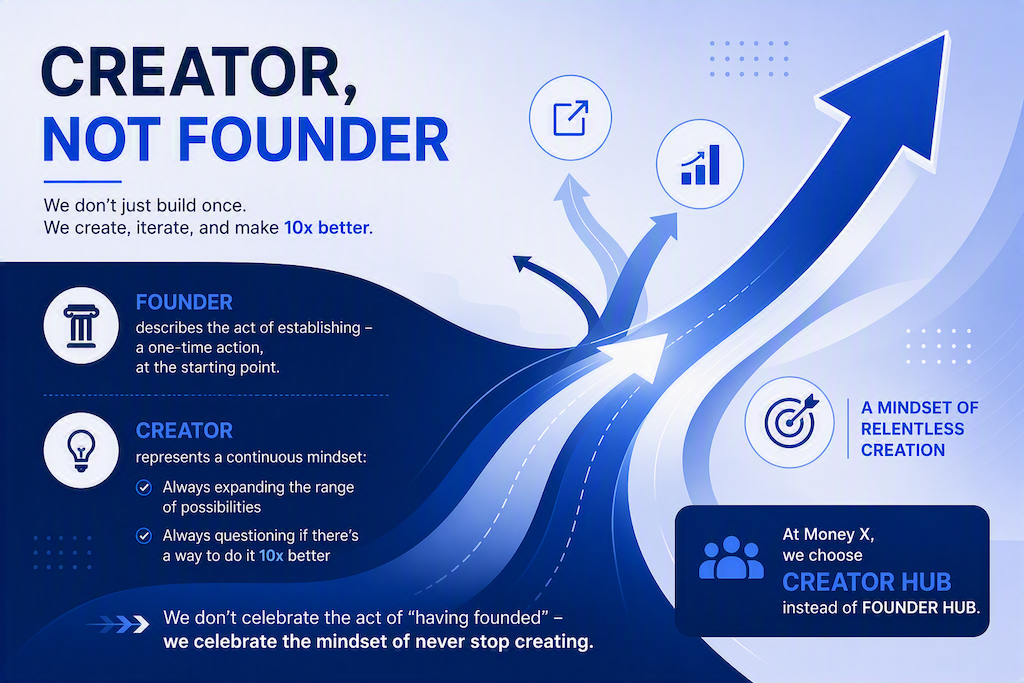
That is precisely why I prefer the term Creator (someone who builds and brings ideas to life) over Founder (someone who establishes a venture). "Founder" emphasizes the act of establishing something or laying its foundations, tied to a milestone at the beginning. "Creator" emphasizes an ongoing mindset and journey: continually expanding the range of possibilities, always asking whether there is a way to do something ten times better, and then turning that possibility into reality, step by step.
If "creativity" emphasizes the ability to discover something novel, then "value creation" more fully captures the spirit of Creator that I mean: going beyond ideas to actively build, test, refine, and create value in the real world. Creativity opens up possibilities; value creation turns those possibilities into reality.
That is why, at Money X, you will find Creator Hub rather than the conventional Founder Hub. We do not simply want to celebrate having established a business or laid its first bricks. We want to celebrate those who never stop creating value—those who continually turn ideas into solutions, solutions into value, and value into a foundation for growth.
Intuition Guides Value Creation
In August 2025, YouTube recommended the Nhận Thức Mới channel to me. I started watching and became a regular viewer. To me, it is one of the most noteworthy knowledge-focused channels on the platform, alongside, of course, Moneyholic™. Much of its content touches on questions I often contemplate, particularly the origins of life, the purpose of existence, and consciousness, as well as the role of intuition in discovery and invention.
Stories about Einstein's intuition, Tesla's inspiration for inventions, and Mendeleev's dream of the periodic table have made me think deeply about how ideas emerge.
Einstein said that intuition is the only truly valuable thing ("The only real valuable thing is intuition"). Tesla, who had more than 1,000 inventions to his name, is said to have stated that he did not invent anything himself; his brain was merely a receiver, and somewhere in the Universe there was a core from which we receive knowledge, strength, and inspiration. He had not penetrated the secrets of that core, but knew it existed ("My brain is only a receiver, in the Universe there is a core from which we obtain knowledge, strength and inspiration. I have not penetrated into the secrets of this core, but I know that it exists"). Mendeleev, meanwhile, recounted that the periodic table of chemical elements came to him in a dream rather than through step-by-step logical reasoning ("I saw in a dream a table where all the elements fell into place as required. Awakening, I immediately wrote it down on a piece of paper, only in one place did a correction later seem necessary").
On the subject of the origins of life, this content has also prompted me to consult multiple sources and clearly distinguish the question of how life emerged from the question of how species evolved. If you have ever believed in Darwin's theory of evolution - from the evolutionary relationship between humans and other primates to the origins of birds in a branch of ancient dinosaurs - follow the channel and actively explore different sources of information to recognize "the greatest deception in the history of science."
Although the authenticity of these quotations and anecdotes requires caution, I still find a valuable suggestion in them: sometimes, intuition helps us recognize a possibility before we can explain it through clear reasoning. But recognizing a possibility does not mean we have already created value. The path from an initial hunch to a useful solution still involves research, verification, experimentation, and refinement. That is the transition from creativity to value creation.
These reflections remind me of the "Soul of the World" in The Alchemist and the search for "the Creator" in the Prometheus film series. They also help clarify why we chose Creator rather than Founder: not merely discovering something new, but gradually bringing it into reality. In that sense, a Creator is not only someone who comes up with ideas, but also someone who builds and brings them to life.
More importantly, I have come to understand the role of intuition more clearly when practicing the ZiZoZi method: opening up creative ideas, then bringing them into a process of analysis, experimentation, and realization. I call this shift in understanding my Second Enlightenment, and I am preparing a third video on Moneyholic to share how to integrate intuition into this process. To me, intuition does not replace systematic thinking; it opens up possibilities for thought and action to explore further.
There is No Final Version
I have never regarded the current version of ZiZoZi as a fully developed creative thinking method for myself. If you have read The Alchemist, you will surely remember the line: "Everything that happens once can never happen again. But everything that happens twice will surely happen a third time." Each time I practice, I have another opportunity to revisit how I ask questions, seek ideas, and turn ideas into results. The book always makes me reflect on recurring experiences and what we can continue to discover along our journey.
I believe there will be a Third Enlightenment, a Fourth, and perhaps many more in the future. Each is a new version, not the final one. It resembles a familiar experience for office workers: a file is named "revised," then "final," then "final 1," "final 2"... Every time we think we are finished, we discover something else that needs adjusting.
That is also how I see the role of a Creator. A Founder is tied to a milestone in the past; a Creator emphasizes an ongoing journey: always zooming in to examine the details, zooming out to see the whole picture, then zooming in again with a new perspective. Each perspective is not just about generating more ideas, but also about adjusting how we work and creating greater value.
At Money X, we do not want to confine ourselves to a moment that has already passed. We want to continue being Creators: constantly learning, generating ideas, testing them, and bringing useful things into reality. Every day is an opportunity to create new value while becoming a better version of ourselves.
Money X ‣ Lean · Smart · Exponential